Catch a whiff of jasmine on a warm evening and you might suddenly find yourself back in your grandmother’s garden, decades ago, without ever meaning to go there. That jump – instant, uninvited, almost cinematic – isn’t a coincidence or a poetic exaggeration. It’s wired directly into the architecture of your brain. Flower scents, more than almost any other sensory input, have a peculiar shortcut to memory, and researchers have spent the last few decades figuring out exactly why.
Why smell gets a direct line to memory when other senses don’t
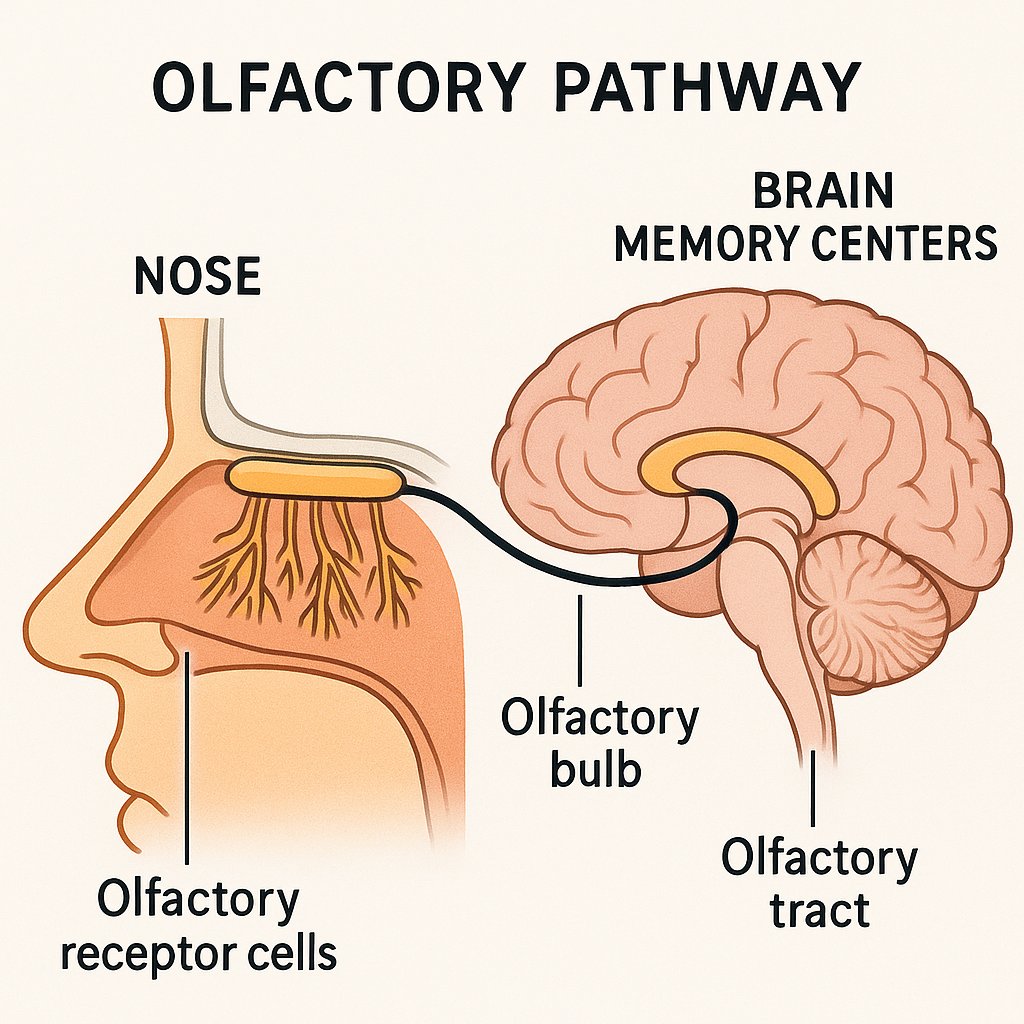
Most sensory information takes a scenic route through the brain. Sound and sight, for instance, get processed by the thalamus first, which acts like a switchboard operator, before being routed to the appropriate region. Smell skips that step entirely. Olfactory signals travel straight from receptors in your nose to the olfactory bulb, which sits right next to – and shares dense neural connections with – the amygdala and the hippocampus. Those two structures happen to be the brain’s emotional processor and its memory filing system, respectively.
That’s the anatomical reason floral scents feel so loaded with feeling. There’s no middleman softening the impact. When rose or lilac molecules bind to olfactory receptors, the signal essentially lands in the same neighborhood where emotional memories get stored and tagged. Scientists call this the “Proust phenomenon,” named after the famous scene in Marcel Proust’s novel where a madeleine dipped in tea triggers a flood of childhood memories. Researchers at institutions like Rockefeller University and the Monell Chemical Senses Center have confirmed the effect using controlled experiments, showing that odor-evoked memories tend to feel more emotional and more vivid than memories triggered by a photo or a song, even when the memory itself is decades old.
Which flower compounds do the heaviest lifting
Not all floral smells affect the brain the same way, and the differences come down to chemistry.
- Linalool – found in lavender and some rose varieties, this terpene alcohol has been shown in EEG studies to shift brain wave activity toward relaxation, which is partly why lavender is so consistently linked to calmer, gentler memory associations.
- Phenylethyl alcohol – the dominant compound in rose scent, it’s mild and slightly sweet, and studies suggest it can lower stress-related cortisol levels within minutes of exposure.
- Indole – present in jasmine and orange blossom in small concentrations, it smells floral and pleasant; in larger doses it turns unpleasant, almost fecal. That dual nature is a good reminder that “natural” doesn’t automatically mean simple or universally pleasant.
- Geraniol – common in geraniums and some roses, associated in several small trials with reduced anxiety markers during exposure.
What’s interesting is that these molecules don’t need to be “understood” consciously to have an effect. The amygdala reacts to chemical signatures before the conscious mind even labels the smell as “flowery” or “nice.” That’s part of why scent memories can feel so involuntary – you’re reacting before you’re really thinking.
The specificity problem: why one person’s comfort scent is another’s trigger
I’ve noticed, talking to people about this, that reactions to the same flower can be wildly different. Gardenia might make one person think of a wedding and another think of a funeral, simply because that’s where they first encountered the smell in a strong emotional context. This is called odor-associative learning, and it happens fast – sometimes after a single exposure, especially if the moment carried high emotional weight. A 2013 study published in Frontiers in Behavioral Neuroscience found that emotionally charged first encounters with a scent create stronger and more durable associations than neutral ones, which explains why a flower can smell like nostalgia to one person and like dread to another.
This also means floral scent is not a reliable universal mood tool the way, say, caffeine’s stimulant effect is. Context matters enormously. Anyone marketing calming lavender diffusers or nostalgia-driven candle scents runs into this limitation constantly – the biology is real, but the meaning attached to it is personal.
Can flower scents actually improve memory, or just evoke it?
This is where things get more nuanced. Evoking an old memory and improving memory formation are two different mechanisms, and the research treats them separately.
On the recall side, evidence is fairly strong: familiar floral odors reliably help people retrieve autobiographical memories faster and with more emotional detail than visual or auditory cues. That’s the Proust effect in action.
On the formation side – meaning, does smelling flowers while studying or working actually help you remember new information better – the picture is more mixed but still promising. A well-known 2007 study out of Germany had participants learn word pairs while exposed to rose scent, then re-exposed them to the same scent during deep sleep. Recall improved significantly compared to a no-scent control group, suggesting the scent helped consolidate memory during sleep, a stage when the hippocampus is busy replaying and filing the day’s experiences.
Later studies using lavender and jasmine have shown smaller but measurable effects on task performance and stress-related memory impairment, particularly in situations involving anxiety, where floral scents seem to buffer the negative impact of stress hormones on memory formation.
| Compound | Common source | Observed effect |
|---|---|---|
| Linalool | Lavender, rose | Relaxation, reduced anxiety |
| Phenylethyl alcohol | Rose | Lower cortisol, mild calming |
| Geraniol | Geranium, rose | Reduced anxiety markers |
| Indole (low concentration) | Jasmine, orange blossom | Pleasant floral association |
A practical angle: using scent intentionally
If you want to put any of this to use – and plenty of people do, whether for studying, easing anxiety, or just building better memories on purpose – a few things seem to matter based on the research:
- Consistency helps. Using the same scent repeatedly during a specific activity (studying, meditating, journaling) builds a stronger association over time than a one-off exposure.
- Concentration matters. Overwhelming floral intensity can trigger the opposite reaction – some of the same compounds that feel pleasant at low doses become irritating or nauseating at high ones.
- Timing counts. Scent exposure close to sleep appears to support memory consolidation more effectively than exposure during a fully alert, distracted state.
None of this makes floral scent a memory-enhancing miracle. It’s more like a subtle amplifier – it doesn’t create memories out of nothing, but it can make emotionally meaningful moments stick a little harder, and it can pull old ones back to the surface with unusual speed and clarity.
What this really tells us about smell and the mind
The science here keeps pointing to the same idea: scent, especially floral scent, isn’t just decoration for the senses. It’s tangled up directly with how the brain files away emotional experience. That’s a strange kind of intimacy for something as simple as a flower in a vase. If you’re curious to go deeper, there’s a growing body of neuroscience literature on olfaction and memory worth exploring – it turns out the nose might know more about who we are than we tend to give it credit for.