The first bouquet I ever made for a friend’s dinner party looked like a salad. Seven different flowers, all the same height, packed tightly into a round vase. Nothing was wrong with the flowers. The problem was the arrangement. Years later, I learned that three simple principles explain why some bunches of grocery-store stems look expensive and others look chaotic: the rule of thirds, odd numbers, and a restrained color scheme.
None of these require special training or a florist’s cooler. They are visual habits, and once you see them, you will notice them in every well-made centerpiece.
The rule of thirds: why your vase is not a blank wall
Photographers and interior designers use the rule of thirds to create balance without making things stiff. Florists borrow it for the same reason. Two versions are worth knowing.
Height: one-third vase, two-thirds flowers
A common guideline is that the flowers should rise about one and a half to two times the height of the container. Put another way, the vase takes up roughly one-third of the total height and the blooms and foliage take up the other two-thirds. A 6-inch vase, then, wants stems that reach about 9 to 12 inches above the rim.
Too short, and the arrangement looks squat and heavy. Too tall, and it looks top-heavy and tips over. For a dining table, I usually err on the shorter side so guests can still see each other across the table. Anything above eye level while seated (roughly 14 to 16 inches from the tabletop) starts to feel like a barrier.
Placement: don’t aim for dead center
The second use is visual. Imagine your arrangement divided into three zones, either vertically or diagonally. Instead of placing your largest bloom in the exact middle, set it off-center, about a third of the way across. Then let smaller flowers and foliage trail away from it. The eye moves around the arrangement rather than stopping at a single point.
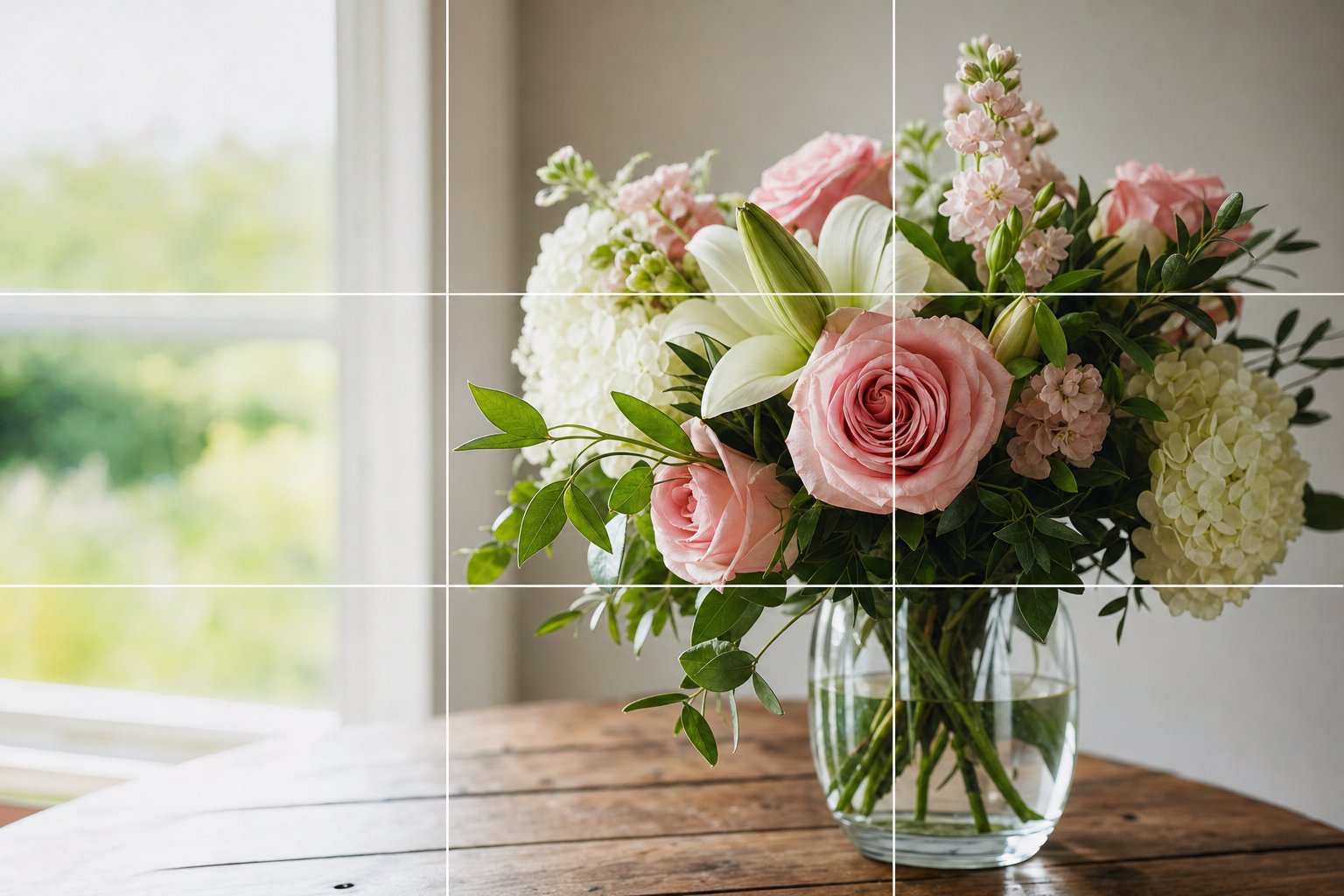
A quick trick: build your arrangement in three layers. Start with greenery as the base, add your main “focal” flowers in the middle zone, and finish with light, airy fillers or a few tall accent stems at the top.
Why odd numbers just work
Ask ten florists and most will tell you the same thing: group flowers in threes, fives, or sevens. An even number of stems tends to settle into pairs, which creates symmetry. Symmetry is fine for formal settings, but it can read as static. Odd groupings force the eye to move, and they naturally create a slightly asymmetrical, more organic shape.
Here is how I apply it in practice:
- Small bud vase: 3 stems of a single flower, or 1 focal bloom plus 2 smaller accents.
- Everyday table arrangement: 5 focal flowers, 3 filler stems, and a handful of greenery.
- Large statement piece: 7 or 9 focal blooms, grouped in clusters rather than spread evenly.
Beyond about nine, the effect fades. Nobody counts 13 versus 14 tulips, and the arrangement reads as a mass anyway. The rule matters most in smaller compositions where each stem is visible.
One caution: the odd-number rule applies to each type of flower, not to the total. A bouquet of three roses, five snapdragons, and three stems of eucalyptus works well even though the combined count is eleven. Think in groups.
Simple color schemes that rarely fail
Color is where beginners overcomplicate things. A flower market in May is overwhelming, and it is tempting to grab one of everything. Instead, pick a scheme before you shop.
- Monochromatic: Different shades of one color, such as blush, rose, and deep pink. This is the easiest way to look polished. Vary texture (ruffled ranunculus next to smooth tulips) so it doesn’t flatten out.
- Analogous: Colors sitting side by side on the color wheel, like yellow, orange, and soft peach. These feel warm and harmonious.
- Complementary: Opposites on the wheel, such as purple and yellow or blue and orange. Use one color as the dominant (about 70 percent) and the other as an accent.
- White and green: Almost impossible to get wrong, and it suits any room. Mix hydrangea, white stock, and several greens for depth.
A good guideline is to limit yourself to two or three main colors, plus greenery. Foliage counts as a neutral. If you want a pop of something unexpected, keep it to one or two stems. A single chartreuse lady’s mantle in a white-and-blush bouquet can make the whole thing feel intentional.
Common mistakes, and quick fixes
- Stems not cut at an angle. A fresh diagonal cut of about an inch lets flowers drink better and last longer.
- Leaves below the waterline. They rot and cloud the water. Strip them off.
- Everything at the same height. Stagger your stems so some sit lower and others reach up.
- Ignoring the vase. A clear, narrow-necked vase supports stems; a wide bowl may need a grid of floral tape across the top.
Start small, and trust your eye
These three principles are guidelines, not laws. Once you are comfortable, bend them. A single dramatic branch in a tall vase breaks every rule and still looks great. But for your next trip to the farmers market or grocery store, try this: choose one color scheme, buy flowers in groups of three or five, and cut stems so the blooms rise about twice the height of your vase. Make one arrangement, then another a week later. By the third, you will start seeing proportions and balance almost automatically, and that is the point where flower arranging stops feeling like a puzzle and starts feeling like a pleasure.








