A young woman in 1852 London receives a small bouquet at her doorstep – no card, no note. Just a cluster of marigolds tied with striped ribbon, a sprig of ivy, and a single yellow rose. To a modern reader, it looks like a pretty accident of color. To her, it was a message she could decode in seconds, and possibly one that changed the course of her afternoon. That’s the strange, quiet world of floriography, the Victorian “language of flowers,” and it’s a lot richer – and stranger – than the greeting-card version we usually hear about.
I’ve spent a fair amount of time digging through old floral dictionaries for research projects, and what strikes me every time is how seriously people took this stuff. It wasn’t a parlor game. In a society obsessed with propriety, where a man and woman couldn’t just say “I love you” or “I don’t trust your intentions” out loud, flowers became a workaround. A whole silent vocabulary grew up around bouquets, and understanding it tells you a surprising amount about how Victorians actually lived and communicated.
Why flowers became a substitute for plain speech
Victorian England, roughly 1837 to 1901, ran on rules. Unmarried men and women were rarely left alone together. Direct declarations of romantic interest were considered forward, even scandalous, especially for women. Yet people still fell in love, still quarreled, still wanted to flirt or warn or apologize. Flowers filled that gap.
The trend actually has roots outside England – it borrowed heavily from Ottoman Turkish traditions of “selam,” a system of assigning meaning to objects, which European travelers wrote about in the early 1700s. Lady Mary Wortley Montagu, wife of the British ambassador to Constantinople, described this practice in her letters home around 1717, and the idea eventually crossed into French salons before landing in Britain. By the 1820s and 1830s, floral dictionaries – books that listed flowers alongside their supposed meanings – were being published in France and quickly translated and adapted for English readers.
What made it take off in England specifically was the Victorian appetite for symbolism and sentiment combined with a genuine passion for gardening and botany. Queen Victoria’s own reign coincided with huge advances in glasshouse technology, plant collecting from the colonies, and a growing middle class with gardens and conservatories to fill. Flowers were everywhere in daily life, so it made sense they’d become loaded with meaning.
How the “dictionaries” actually worked
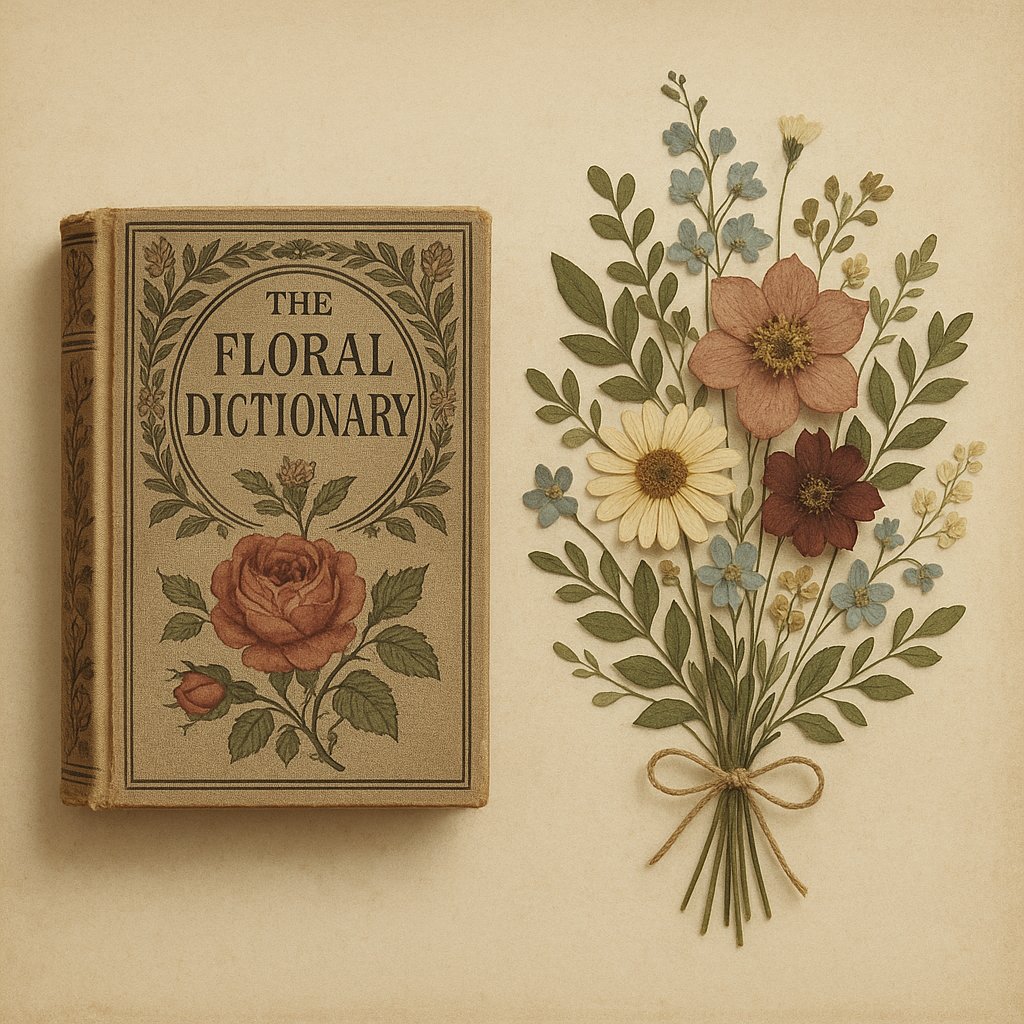
Here’s where it gets messy, and honestly, a little funny. There was no single universal codebook. Books like “The Language of Flowers” by Kate Greenaway (1884) or earlier ones like Henry Phillips’ “Floral Emblems” (1825) each assigned their own meanings, and they didn’t always agree. A red tulip might mean “declaration of love” in one dictionary and something entirely different in another.
Some meanings did become fairly standard across most sources:
- Red rose – romantic love, passion
- Yellow rose – jealousy, or in some editions, friendship
- Daisy – innocence, loyal love
- Ivy – fidelity, wedded love
- Marigold – grief or despair
- Lavender – distrust, or devotion, depending on the source
- Snapdragon – deception or refusal
- Forget-me-not – true, lasting memories
Notice how a couple of these contradict each other depending on the book. That inconsistency is one of the things I find most fascinating – and a little suspicious, honestly. It suggests floriography was as much a fashionable pastime and a marketing hook for publishers as it was a rigorously shared code. People bought these little dictionaries the way we might buy a coffee-table book today: partly to use, partly to display good taste.
Presentation mattered as much as the flower itself
This is the part most casual explanations skip. It wasn’t only which flowers you chose – it was how you arranged and delivered them.
- A flower handed with the right hand meant “yes”; with the left hand, it meant “no.”
- An upside-down bloom could reverse or negate its usual meaning entirely.
- The way ribbon was tied, or whether the bouquet leaned to one side, could add nuance.
- Wearing a flower over the heart signaled affection; wearing it in the hair suggested caution or coquetry.
So the same handful of blossoms could send wildly different messages depending on delivery. This layered complexity is probably why floriography never became as precise or reliable as, say, Morse code – it was more art than science, closer to reading tone in a letter than decoding a cipher.
Everyday uses beyond courtship
Romance gets most of the attention, but flowers carried social weight in other corners of Victorian life too. Mourning customs, for instance, leaned heavily on floral symbolism – white lilies for purity of the departed soul, cypress branches for grief, rosemary for remembrance at funerals. Given how high infant and childhood mortality rates were during this period, mourning floriography wasn’t a niche interest; it touched nearly every household at some point.
Flowers also showed up in friendship and family correspondence. A pressed violet tucked into a letter to a sister might simply mean “thinking of you,” without any romantic undertone at all. And in more competitive social circles, floral gifts occasionally carried subtle jabs – a bouquet heavy with yellow carnations, associated with disdain in some dictionaries, sent to a rival hostess after a disappointing dinner party, say.
What actually survives from this tradition today
A few threads of floriography made it into modern life, even if most people don’t realize the history behind them:
- Red roses for romantic love – still the dominant association today.
- White lilies at funerals – a direct continuation of Victorian mourning customs.
- Forget-me-nots used in memorial jewelry and remembrance events.
- Wedding bouquets still occasionally chosen with symbolic meaning in mind, even if guests don’t decode them.
What we’ve lost is the fluency – the assumption that an educated person could actually “read” a bouquet the way they’d read a short note. That skill faded by the early twentieth century as direct communication became more socially acceptable and floral dictionaries went out of print.
A quiet history worth remembering
What I find genuinely charming about this whole tradition is how much creativity and restraint it demanded. Victorians couldn’t just say what they meant, so they built an entire sensory shorthand instead – one built on scent, color, texture, and gesture. It’s a reminder that communication doesn’t always need words to carry weight.
If you ever come across an old pressed-flower book or a Victorian greeting card with a cluster of blooms illustrated on it, it’s worth pausing to wonder what that particular combination might have been trying to say. Somewhere in a forgotten dictionary from 1875, there’s probably an answer.