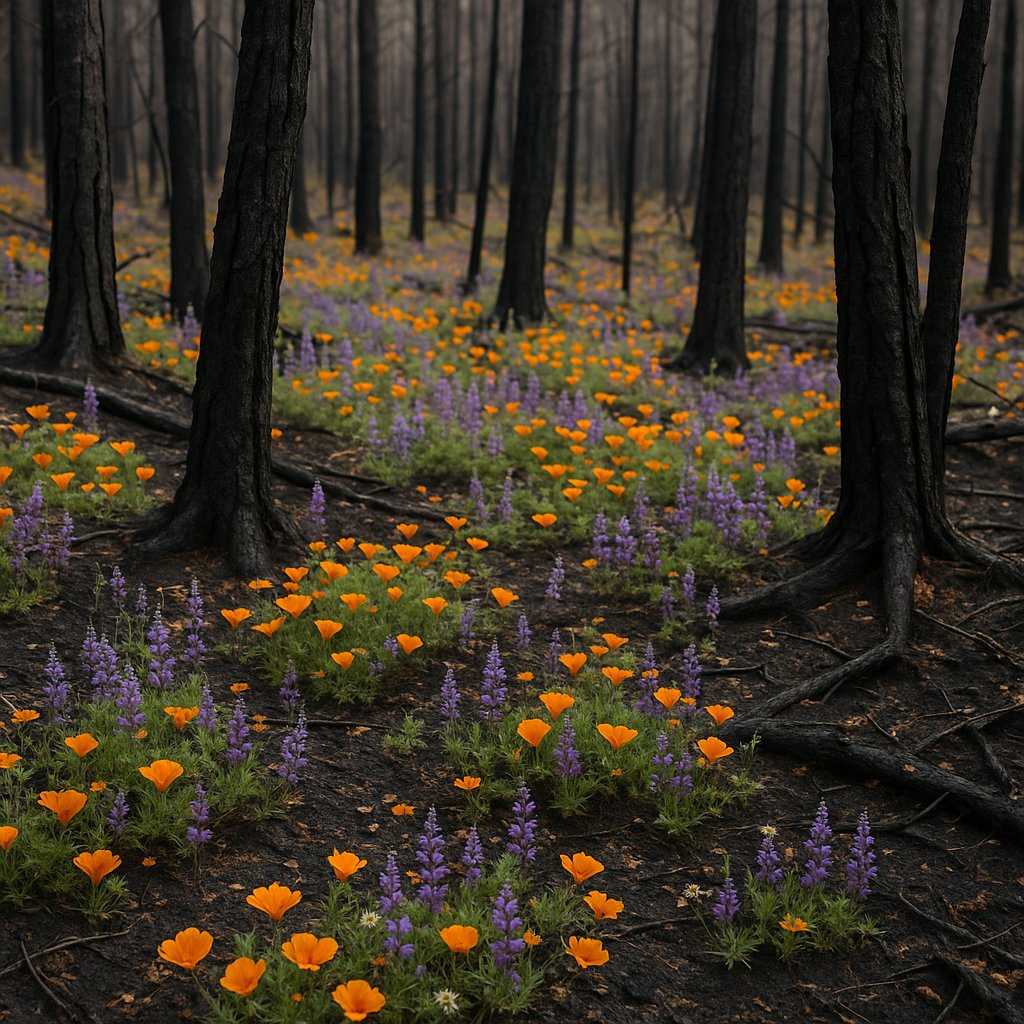
Walk through a burned patch of chaparral in Southern California a few weeks after a wildfire, and you might expect a wasteland of ash and blackened stumps. Instead, you’re likely to find something startling: a carpet of flowers that nobody planted, in colors so vivid they almost look artificial against the charred ground. These are “fire followers,” and they’re one of the strangest, most elegant tricks in the plant kingdom. Some of these species won’t bloom – won’t even germinate – unless fire has swept through first. Understanding why gets you into some genuinely fascinating plant biology, and it changes how you think about wildfire itself.
Seeds that wait for decades, not days
Most garden seeds germinate within days or weeks under the right conditions of moisture and warmth. Fire-follower seeds play a longer game. Species like whispering bells (Emmenanthe penduliflora), fire poppies (Papaver californicum), and various species of phacelia can lie dormant in the soil for 50, 80, sometimes over 100 years, waiting for a signal that never comes from rain or sunlight alone.
That signal is smoke – or more precisely, chemical compounds produced when plant material burns. Researchers identified the key trigger back in the early 2000s: a compound called karrikin, found in wood smoke, which acts almost like a hormonal alarm clock for buried seeds. Even diluted smoke-infused water sprayed on soil in a lab can coax these seeds into germinating, no actual flames required. I’ve seen home gardeners in fire-prone regions experiment with commercial “smoke water” products just to get notoriously stubborn native seeds to sprout, which tells you how powerful this cue really is.
Heat matters too, but not for every species
Smoke isn’t the only mechanism at play. Some seeds, particularly those with hard, waxy coats, need the physical heat of fire to crack them open. This is called heat scarification. Certain manzanita and ceanothus species fall into this category – their seed coats are so tough that without the intense but brief heat pulse of a fire passing over the soil, water simply can’t penetrate to trigger germination. It’s a bit like a seed wearing armor that only fire can pierce.
Interestingly, the two triggers aren’t mutually exclusive. Some fire-follower species respond to both smoke chemicals and heat, which suggests they’ve evolved multiple redundant systems to make sure they only wake up under genuinely favorable conditions – meaning after a real fire, not just a warm afternoon.
Why bother waiting for disaster?
From an evolutionary standpoint, this strategy makes a surprising amount of sense. Fire clears away the canopy and understory competition that would otherwise shade out small annual plants. It also releases a pulse of nutrients – nitrogen, phosphorus, potassium – locked up in dead plant tissue, essentially fertilizing the soil overnight. And it removes leaf litter and dense root mats that would physically block a tiny seedling from reaching sunlight.
In short, a freshly burned landscape is, paradoxically, one of the best possible nurseries for certain plants. There’s less competition, more light, more nutrients, and often more exposed mineral soil for roots to grab onto. Fire followers have essentially evolved to specialize in this narrow but predictable window of opportunity.
- Reduced competition: shrubs and trees that normally dominate are knocked back, giving smaller plants a rare shot at sunlight.
- Nutrient pulse: ash deposits minerals that would otherwise stay locked in standing vegetation for years.
- Open soil: exposed mineral soil is easier for delicate roots to penetrate than compacted, litter-covered ground.
- Pollinator abundance: mass blooms attract bees and other pollinators in high numbers, boosting seed set for the whole population.
A blink-and-you-miss-it bloom
What makes fire followers even more remarkable is how brief their appearance usually is. Many of these species complete their entire life cycle – germination, growth, flowering, seed production – within a single growing season after a fire. Then they vanish again, sometimes for decades, as shrubs and trees regrow and shade the ground once more. Botanists sometimes call this a “seed bank” strategy, where the visible plant is almost incidental; the real biological investment is in the dormant seeds patiently sitting underground, waiting for the next disturbance.
This is part of why fire-follower blooms can feel almost mythical to hikers who happen to catch one. After the 2018 Woolsey Fire in the Santa Monica Mountains, for instance, botanists documented dense stands of fire poppies that hadn’t been recorded in that area for generations. Nobody planted them. They’d simply been waiting in the soil the whole time.
What this means for how we manage wildfire-prone land
This biology has real implications beyond curiosity. Fire suppression policies throughout the twentieth century, which prioritized putting out every fire as fast as possible, likely suppressed these natural blooming cycles across huge areas of the American West. Some ecologists argue that decades of fire exclusion contributed to the decline of certain native wildflower populations, since their seed banks never got the chemical or thermal trigger they needed.
Today, many land managers use prescribed burns partly for this reason – not just to reduce fuel loads and wildfire risk, but to restore the natural disturbance cycles that fire-adapted plants depend on. It’s a reminder that fire in these ecosystems isn’t purely destructive. It’s woven into the reproductive strategy of species that have been co-evolving with periodic burns for thousands of years.
So the next time you hear about a wildfire scorching hillsides in California, Arizona, or the Pacific Northwest, it’s worth remembering that somewhere beneath that blackened soil, there may be seeds quietly waiting for exactly that moment. Given a season of rain afterward, those hillsides can turn into some of the most spectacular wildflower displays in North America. If you’re curious to see this phenomenon firsthand, keep an eye on regional native plant society reports the spring after a local fire – timing your visit right can mean witnessing a bloom that won’t repeat again for decades.